A bright speck of climate news was quickly overshadowed by the
presidential election this week—America’s children have officially won
the right to sue their government over global warming.
Yesterday, a lawsuit filed by 21 youth plaintiffs was ruled valid
by US District Judge Ann Aiken in Eugene, Oregon. A group of citizens,
whose ages range from nine to 20, charged President Obama, the fossil
fuel industry, and other federal agencies with violating their
constitutional rights by declining to take action against climate
change.
“Federal courts too often have been cautious and overly
deferential in the arena of environmental law, and the world has
suffered for it,” wrote Judge Aiken in her ruling.
Along with renowned climate scientist James Hansen, who in 1988 pleaded with Congress to consider the harmful effects of greenhouse gas emissions, the youth group was applauded by activists who saw their lawsuit
as a much-needed beacon of hope for future generations. In it, the
plaintiffs accused the US government and energy trade industries of
endangering their rights to life, liberty, property, and to vital public
trust resources.
In 2015, the National Association of Manufacturers (NAM), the
American Fuel & Petrochemical Manufacturers (AFPM), and the American
Petroleum Institute (API), along with the US government, motioned for
the case to be thrown out before US Magistrate Judge Thomas Coffin.
Their opposition was based on a “lack of subject matter jurisdiction and
failure to state a claim.” Judge Coffin rejected their motion, although
the defendants appealed, and was later succeeded by Judge Aikin after
his retirement.
See what it can do. A new surgical robot can make the micro-scale
movements needed for a particularly delicate procedure: cataract
surgery.
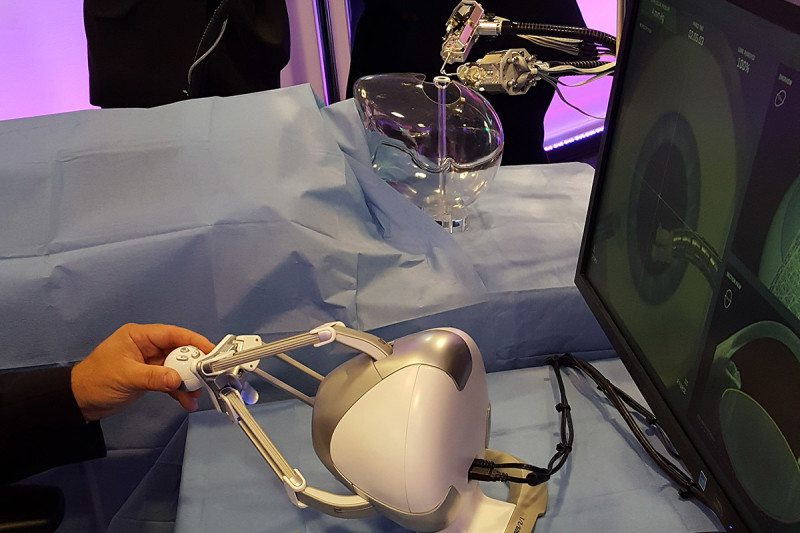
Axsis, a system developed by Cambridge Consultants, is a small,
teleoperated robot with two arms tipped with tiny pincers. It’s designed
to operate on the eye with greater accuracy than a human.
Globally, 20 million people
have cataract surgery every year, making it one of the most common
surgeries in the world. Although complications are very rare, they still
affect tens of thousands of people.
Cataracts happen
when the natural lens of the eye gets cloudy and obscures vision. To
restore a person’s sight, a surgeon cuts a small hole in the lens,
scoops out the bit that’s gone cloudy, and replaces it with what’s
essentially a permanent plastic contact lens.
Watch what you’re doing
Axsis / Cambridge Consultants
The whole thing requires a steady hand, and the most common
complication arises when a surgeon accidentally pierces the back of the
lens, a thin membrane that is only a few millimetres off target, causing
hazy vision.
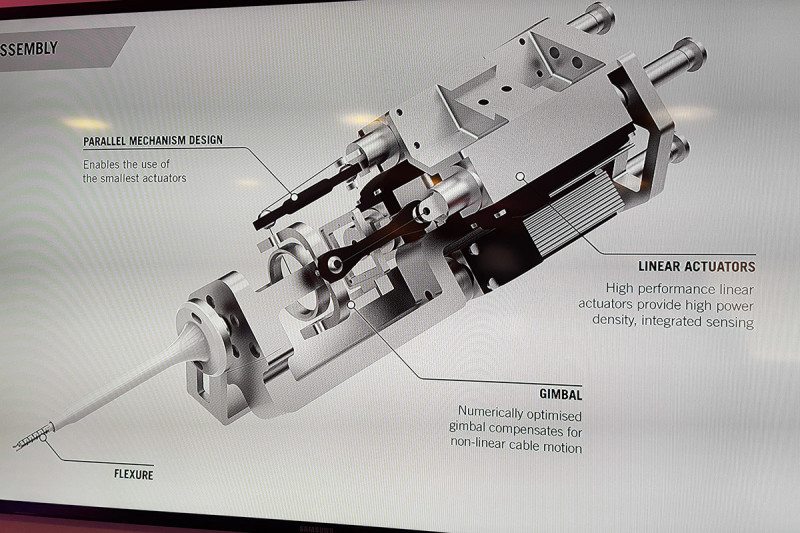
Axsis aims to prevent this kind of human error. The device’s
articulating pincers are mounted on arms about the size of drinks cans,
with extremely light, strong “tendons” made of the same material NASA
uses for its solar sails. These pincers can sweep across a 10-millimetre
space – the size of the lens of the eye. This is just a demonstrations
model; in the final product, the pincers will be replaced with scalpels.
Robo halo
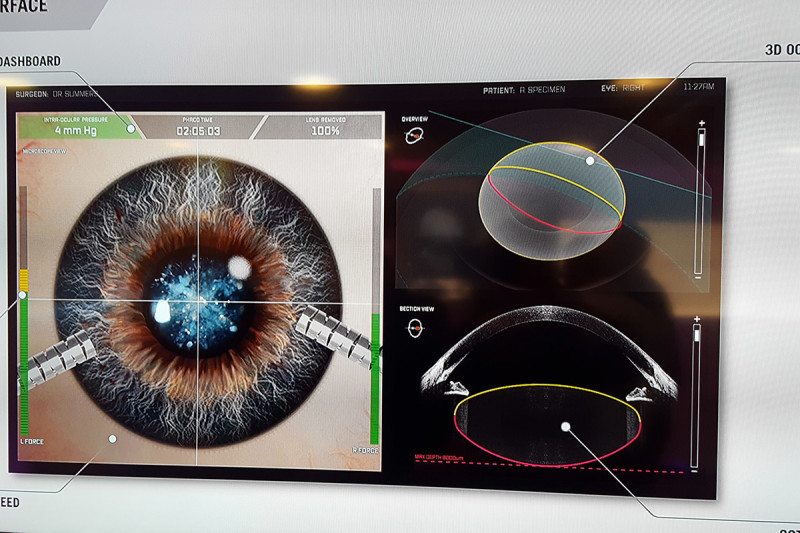
To control the robot, the surgeon sits at a station nearby and uses
two 3D haptic joysticks to move the pincers while watching their work on
a screen. The image on the screen is enlarged, so the surgeon can make
more precise movements, with the pincers operating at a tiny scale not
possible with the human hand.
One benefit of the system is that the software disables certain
boundaries from being breached. “It won’t let you make the mistake of
punching through the back of the lens,” says Chris Wagner, the lead roboticist on the project.
Unable to err
Axsis / Cambridge Consultants
We already use surgical robots,
such as the Da Vinci system, for some other operations. But these
robots are usually quite large, often completely enveloping the patient
and using long, telescoping instruments.
“The attachments need to do huge sweeps outside the body to do minute
movements inside the patient,” says Wagner. Axsis is scaled down to a
small halo around the head. In part thanks to its smaller size, the
system will be cheaper than other robotic surgery techniques.
And while other robots have been designed to work at small scales – even on eyes – they have not done cataract surgery. Trials of a robotic system
developed by Dutch firm Preceyes Medical Robotics are ongoing at
Oxford’s John Radcliffe Hospital and focus on the retina, rather than
the lens.
First eyes, then guts
Ian Murdoch,
an ophthalmologist at University College London, says he is interested
in the idea that Axsis prevents piercing the back of the lens. “This
happens in about 0.1 to 0.7 per cent of cases,” he says. “If the
complication rate is less then this would obviously be great.”
However, Murdoch wonders if Axsis really offers much advantage over
existing advanced cataract surgery techniques, such as laser cataract
surgery.
Smaller than it looks here
Axsis / Cambridge Consultants
Peter Kim, a surgeon at the Children’s National Health System in Washington DC who is working on a larger, autonomous surgical robot, says that microsurgical robots are already used in some clinical settings, such as the NeuroArm robot used in brain surgery. “I applaud the miniaturisation, but I am not clear on the unmet need and value proposition,” he says.
But Axsis’s creators say that cataract surgery is just the start. “I
think it will quickly find more applications,” says Wagner. It could,
for example, be used in gastrointestinal operations. Put the pincer end
of Axsis on an endoscope and it could solve any small problems – like
removing polyps – then and there. “Nowadays, when you find something in
the colon or in the stomach, you leave it there,” says Wagner.
Wagner hopes the robot could one day enable operations surgeons can
only dream of. “We just want to push forward what’s possible.”
Ever wanted to make Natalie Portman yell obscenities at your
neighbors? What if Garey Busey could leave your mother a sexy voicemail
on her birthday? Wanted to prank your little brother by forcing him to
call his crush and profess his love? Adobe has you covered.
When
Adobe released photoshop in 1990, it dreamed of a world where movie
studios and photo editors could do in minutes what once took hours. It
never dreamed the world would take the digital editor and use it to put
celebrity heads on porn star bodies, distort women’s bodies in magazine
cover, and create vile memes.
Now, the same company that gave the
world Photoshop wants to do for the human voice what it did for the
human image—give people the tools to warp it in anyway they see fit. At
the Adobe Max Creativity Conference, the company premiered VoCo: an
audio editing suite that will allow users to make people say whatever
they want just by typing.
Ah, the raucous thrill of a fireworks show. Whether it’s the Fourth of July, Guy Fawkes Night in Britain, or a New Year’s Eve celebration, the ecstasy of loud, flying projectiles that go whizz-bang-pop eludes no human.
But the folks over at Intel, most well known for making the chips that go inside of your computers, want to use fleets consisting of hundreds of drones to create light shows in the night sky instead.
Using small quadcopters that fly in numbers, dubbed Shooting Stars, the company reckons that its drone light shows can “redefine entertainment” by creating “new experiences.”
Intel launched 500 of its Shooting Stars in a test in Germany recently, and the results are watchable below.
The
Shooting Star quadcopter, each of which weighs in at 280g, can stay
flying for around 20 minutes, said Intel, and together the fleet can
create more than four billion colour combinations with its red, green,
blue, and white LEDs.
“With the improved software and animation
interface on the Intel Shooting Star drone, a light show can now be
created in a matter of days instead of weeks or months,” said Intel. The
drone shows could come in stark contrast to the rigorous planning,
cost, and safety aspects tied to traditional firework displays.
According to the American Pyrotechnics Associations, the total annual
fireworks industry revenue in the USA is more than one billion dollars,
with an approximate 3.5 injuries per 100 lbs of fireworks used.
Reusable drones, operated by one pilot as opposed to a crew of safety
stewards and display artists, could eradicate much of this.
“Intel’s
proprietary algorithms can automate the animation creation process by
using an image and quickly calculating the number of drones needed,
determining where drones should be placed and formulating the fastest
path to create the image in the sky.”
We have to admit—it does
look bloody cool. What’s more, Intel says it has worked with the Federal
Aviation Authority (FAA) in the US to fly these drones as a fleet with
just one pilot, meaning that these aerially choreographed feats are
fairly easy to organise.
But Intel isn’t the only one gunning for a fireworks finale. As reported byMarketWatch,
Walt Disney also wants in on the action. The company filed patents for
drones called “Flixels” in 2014—small UAVs that would coordinate in
fleets and put on a sparkling light LED light show.
Either way,
while it’s obvious fleets of drones will soon create incredible night
sky performances that could be tailored for specific events, fireworks
are best kept alight and exploding (as long as they’re not fired at drones).
There’s a bank in Lima, Peru that holds contents so valuable,
they’re hidden behind a thick metal door in an earthquake-proof vault.
They’re not lost Inca gold or mounds of jewels, but thousands and
thousands of potato seeds.
Seed banks serve as a kind of genetic
Noah’s Ark for crops, keeping copies of as many different species of
crops as possible to ensure food security in the future. These seeds are
valuable because they are part of a global movement to preserve crop
diversity.
“There’s a huge, long chain that goes from growing food
to people eating it, and at the very beginning of that chain is
conservation of diversity of crops,” said Colin Khoury, a researcher
associate at the United States Department of Agriculture’s Agricultural
Research Service. “In the past, that conservation wasn’t so necessary.
But over the last 100 to 150 years, we’ve started to lose that diversity
of the fields.”
Traditionally, farmers’ fields would be filled
with a variety of crops and a variety of species within those crops—you
wouldn’t have acre upon acre of Roundup Ready corn, you’d have a dozen
or so varieties of corn all growing alongside each other, Khoury
explained.
But as our farming systems have expanded and become
more industrialized, they’ve also become more uniform. To grow enough
corn to feed millions of Americans, it’s a lot easier if all of the corn
is the same, so the equipment and techniques used can be identical
across the system.
While
this industrialization has benefits—we can feed more people this
way—there are also risks. By having only one or two varieties of a given
crop, it makes it that much easier for insects and pathogens to figure
out how to attack. Plants that were naturally resistant to a particular
pests may lose that resistance as the pest comes into contact with it
more often and evolves ways around that defense.
We saw this taken
to the extreme during the Irish potato famine. In the mid-1800s, much
of Ireland (especially the rural poor) relied almost exclusively on
potatoes for their diet.
When an outbreak of blight began to decimate the potato crops, 1 million people died
from starvation or related disease. There were other factors that
contributed to the famine, but the reliance on a monoculture of potatoes
proved a deadly bargain.
To
counter this in the modern age, we rapidly develop slightly different
varieties to roll out into our fields, Khouly explained.
“Plant
breeders will keep the traits that farmers want, like a tomato that
grows on the vine at the right height to be harvestable by machine, but
they’ll breed certain things to keep up with pests or diseases,” Khouly
said. “Essentially it’s like buying into a very big machine that has to
run faster and faster to keep up.”
In order to ensure we can
continue this process, we need to have lots of genetic materials from
which to mix and match. That’s where the seed banks come into play.
The
Lima-based International Potato Center is just one of thousands of seed
banks around the world. Potatoes have been a staple in the diet of many
of Peru’s indigenous cultures, and hold cultural significance, so it
made sense for the CIP (the International Center for Potatoes’ Spanish
acronym) to be based there and start its seed collection.
“We have
a chance to preserve the diversity that has accumulated through
thousands of years of evolution and domestication,” said Ana Panta, an
in-vitro conservation specialist at CIP. “Potatoes were first cultivated
more than 8,000 years ago and along the way, those ancient varieties
accumulated valuable genes, like resistance to disease.”
There
are more than 4,500 varieties of potatoes—and 7,000 types of sweet
potato—preserved at the bank, representing 80 percent of the world’s
potato genes. By preserving these seeds, plant breeders can have access
to the genes of thousands of varieties to mix and match and create new
species to help us preserve our farming systems.
But the CIP doesn’t stop there, they’re allowing these varieties to continue to evolve in the field. A project called Parque de la Papa
brings together different indigenous communities from the Andes to
continue cultivating local varieties of potatoes, which lets the
potatoes naturally evolve and produce even more species to work with.
Seed
banks are often overlooked as an important part of our food system, but
as the world population continues to balloon, and resources like water
and land become more scarce, we’re going to need to double down on our
efforts to ensure food security. The United Nations has said we need
to increase our food production by 60 percent just to feed everybody by
2050, and an essential part of that will be protecting the world’s seed
banks.
“It’s essential for combating hunger and the future
problems humanity will face with climate change,” Panta said. “This is
why it’s important to preserve these.”